Car Battery Drains Overnight? Here’s What’s Actually Causing It
A car that starts fine every evening and won’t turn over the next morning is one of the more annoying faults to chase, because the car looks completely normal the whole time it’s happening. If your car battery drains overnight and the battery itself tests fine, the problem usually isn’t the battery at all — it’s something quietly pulling current while the car sits there doing nothing.
That “something” is called parasitic drain, and good news first: a small amount of it is completely normal. Every modern car draws a trickle of current overnight to keep the clock, alarm, infotainment memory and various computer modules alive. The question isn’t whether your car draws anything overnight — it’s whether it’s drawing more than it should.
What’s Normal and What Isn’t
As a rough guide, a healthy parasitic draw sits somewhere between 50 and 85 milliamps (mA) on newer vehicles with more onboard electronics, and under 50mA on older, simpler cars. At that level, a healthy battery can sit for weeks without a meaningful drop in charge.
When a car battery drains overnight badly enough to leave you with a dead start in the morning, you’re almost always looking at something pulling well beyond that — sometimes several amps, which is a completely different scale of problem and will flatten even a strong battery in a single night.

Common Culprits Behind an Overnight Drain
A handful of causes account for most real-world cases:
**A light that isn’t switching off.** Boot lights, glovebox lights, under-bonnet lights and door-triggered interior lights are the classic offenders. A door that isn’t quite latching, or a faulty switch, can leave a light on indefinitely without you ever noticing from outside the car.
**Aftermarket accessories wired incorrectly.** Dash cams, stereos, alarms and USB chargers wired directly to the battery instead of through a switched circuit will draw power whether the car is on or off. This is one of the most common reasons a car battery drains overnight on a vehicle that’s otherwise in good condition.
**A faulty relay or computer module that won’t go to sleep.** Modern cars are full of small modules that are supposed to power down after a set period. Occasionally one gets stuck “awake,” drawing current continuously instead of dropping into standby.
**A failing alternator diode.** Less common, but a diode that’s breaking down inside the alternator can let the battery discharge back through the charging circuit even with the engine off.
**An ageing or already-weak battery.** Sometimes there’s no drain at all — the battery itself has lost enough capacity that even normal parasitic draw is enough to leave it short by morning. This is worth ruling out early, since it’s the cheapest explanation to check.
Testing for It Yourself
You don’t need a workshop to do a basic parasitic drain test, just a multimeter and a bit of patience.
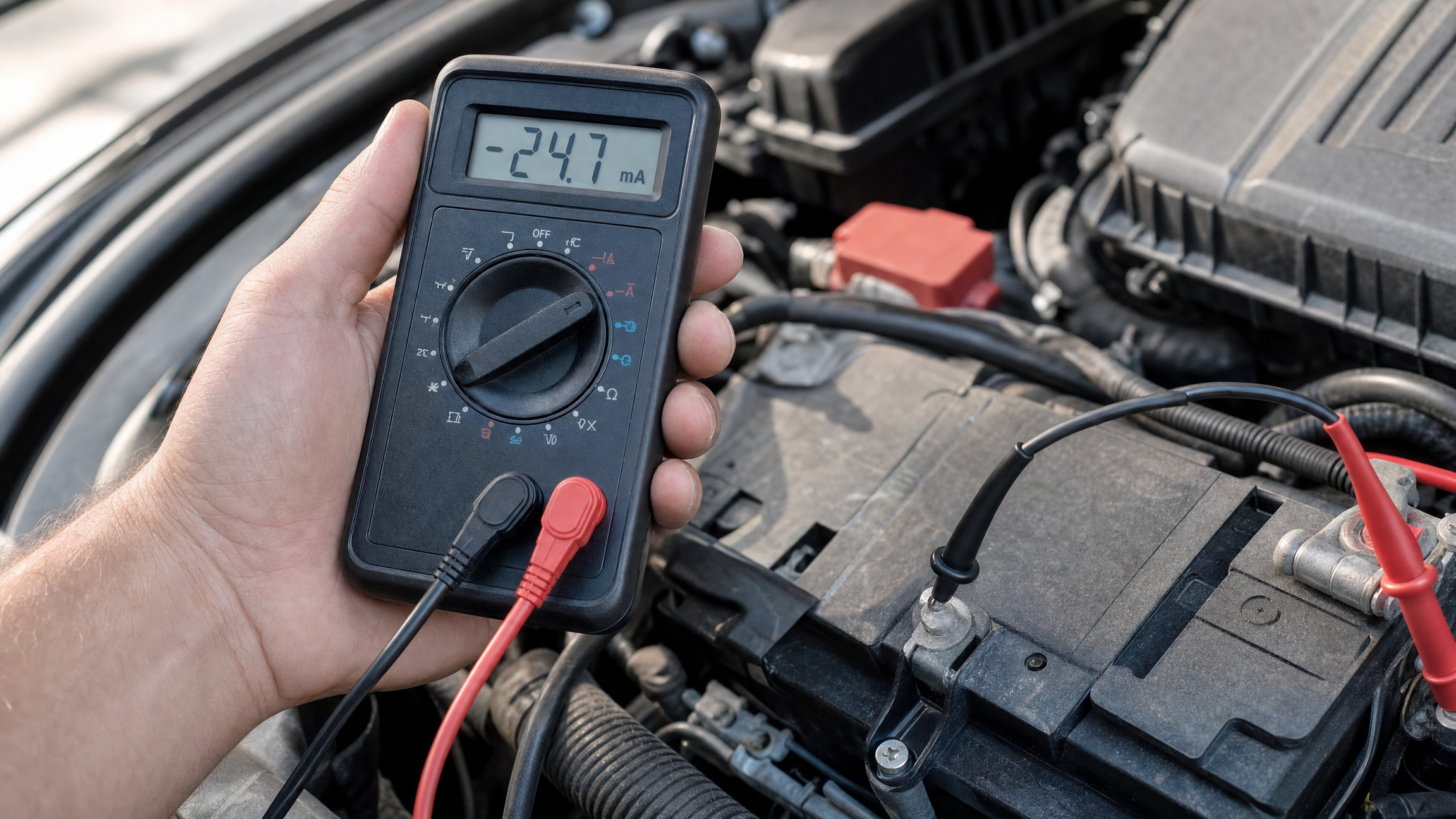
**Step 1 — Get a baseline.** With everything off and the car locked (allow the modules a few minutes to settle into sleep mode first), set a multimeter to DC amps and connect it in series between the negative battery terminal and the negative cable.
**Step 2 — Read the draw.** If you’re seeing a reading well above that 50-85mA normal range, something’s drawing more than it should.
**Step 3 — Pull fuses one at a time.** Working through the fuse box with the meter still connected, pull each fuse in turn and watch the reading. When the draw drops sharply, you’ve found the circuit responsible — the fuse box diagram (usually printed on the inside of the fuse box lid or in the owner’s manual) tells you which component that circuit feeds.
If the number doesn’t move no matter what you pull, the drain may be happening inside the alternator or the battery itself rather than through a fuse circuit, and that’s a job better handed to an auto electrician.
When to Just Get It Checked
If your car battery drains overnight more than once, or the multimeter test points to something beyond a simple interior light, it’s worth getting a proper diagnosis rather than guessing further. A workshop with a proper load tester can usually find the drain and confirm the battery’s actual condition in the same visit — which matters, because a battery that’s been repeatedly flattened by a drain issue ages faster even after the drain itself is fixed.
It’s also worth checking the battery’s age while you’re at it. A battery nearing the end of its working life is far more likely to show problems from a borderline drain that a fresher battery would shrug off without issue.

Stopping It From Happening Again
Once a drain is found and fixed, a couple of habits make a repeat less likely. If you’ve had aftermarket gear fitted — a dash cam, extra lighting, a sound system — ask whoever installed it to confirm it’s wired through a switched circuit rather than straight to the battery, since that’s the single most common cause tradespeople see. It’s also worth doing a quick visual check every so often for interior lights that haven’t fully switched off, especially after fitting new door seals or accessories that could be holding a door-trigger switch slightly open. None of this takes long, and it’s a lot cheaper than another tow truck call-out on a cold morning.
Zeal Auto batteries are built to handle the everyday reality of Australian driving without costing a fortune, and most auto electricians can test one on the spot if you’re chasing a drain and want to rule the battery in or out. Sorting a genuine parasitic drain fixes the actual problem — swapping in a new battery without finding the drain first usually just buys you a few more weeks before the next flat start.